Underwater Localization and Mapping for Cost-Effective Robots
Akshay Hinduja
PhD Thesis, Carnegie Mellon University, 2024
Summary
The full thesis is available here as a PDF (81 pages, 4.9 MB).
This thesis addresses localization and mapping for low-cost underwater robots using imaging sonar and acoustics. It spans degeneracy-aware SLAM factors, acoustic pseudoranging for low-power bio-inspired robots, cGAN sonar filtering for occupancy mapping, and pose-supervised sonar image correspondence (SONIC).
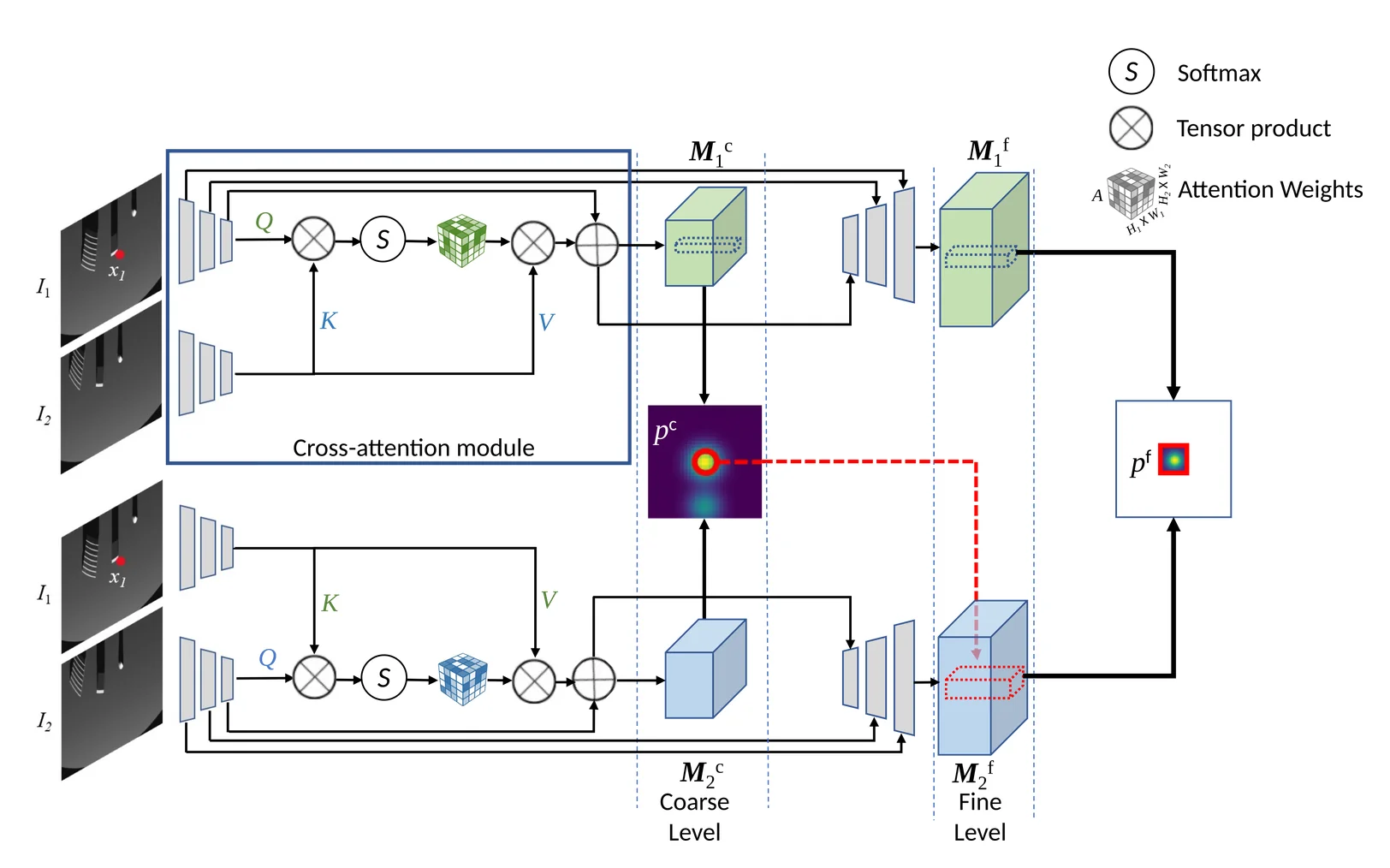
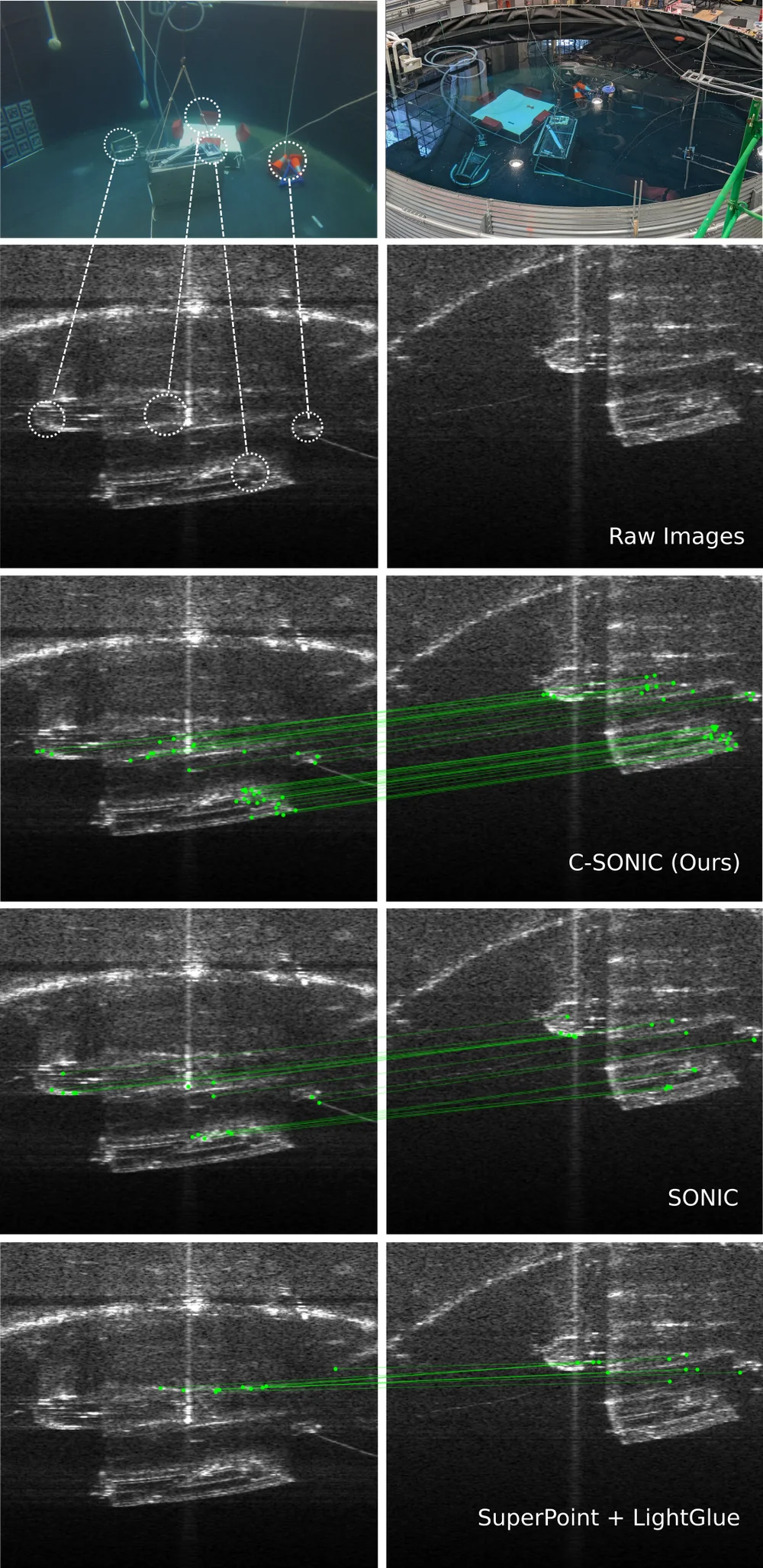
The final chapter, C-SONIC: Cross-Sonar Image Correspondence for Generalized Feature Matching in Imaging Sonars, extends SONIC across sonars. Sonar images change with the frequency mode, the range settings and the manufacturer’s binning, so a network trained on one configuration does not transfer to another. C-SONIC adds a cross-attention module at the encoder level, shown above, so that the feature maps of the two images condition each other before coarse and fine matching. The result is a single model that finds reliable correspondences between images taken with different frequency and range parameters. This opens the possibility of localizing a cheaper vehicle with a lower-cost sonar against a map built by a vehicle with a higher-frequency sonar.
The chapter contributes a cross-sonar matching model that covers most of the Blueprint Subsea Oculus family, together with a framework to train new models on other imaging sonars, and a 550K image-pair dataset with differing frequency and range parameters, pose information and per-frame metadata, including a small subset modeled on the SoundMetrics DIDSON sonar.
Citation
A. Hinduja, "Underwater Localization and Mapping for Cost-Effective Robots,"
PhD thesis, Carnegie Mellon University, Pittsburgh, PA, July 2024.